Rangoli Design Ideas: Meaning, Colours and Easy Diwali Patterns
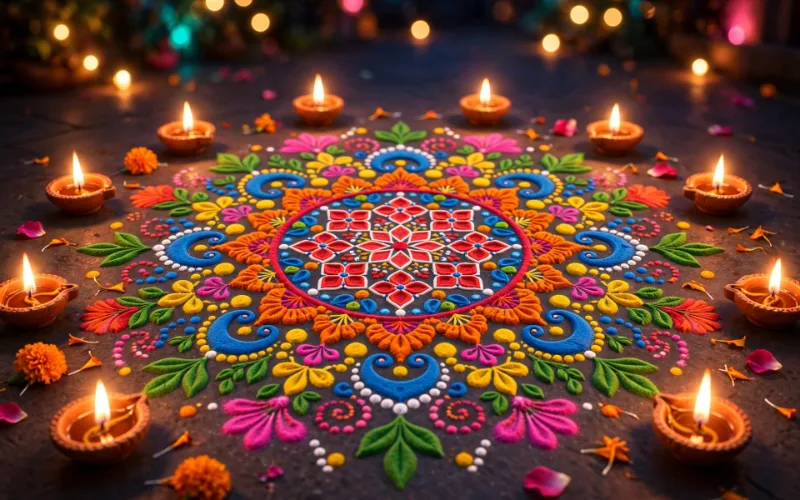
Few sights say "festival" in India like a bright rangoli at the doorstep. For generations, families have woken early to draw these patterns with rice flour, coloured powder and flower petals. A digital rangoli will never replace the real thing, but it is a wonderful way to try out ideas, practise symmetry and plan a design before you kneel down with the colours. This guide covers the meaning behind rangoli, its classic colours and motifs, and a step-by-step method for making designs in GameChakra's Rangoli Maker.
What Rangoli Means
The word rangoli is usually traced to the Sanskrit rangavalli, roughly "a row of colours". It is drawn on the floor, most often at the entrance of a home or in a courtyard, as a sign of welcome and good fortune. During Diwali, many families draw rangoli to welcome Goddess Lakshmi into the home, sometimes with small footprints leading inside.
The art has many regional names and styles:
- Kolam in Tamil Nadu, drawn daily with rice flour, often around a grid of dots.
- Muggulu in Andhra Pradesh and Telangana, especially rich during Sankranti.
- Alpana in Bengal, painted with a white rice paste.
- Mandana in Rajasthan and Madhya Pradesh, drawn on walls and floors.
- Pookalam in Kerala, made from flowers during Onam.
Beyond Diwali, rangoli appears at Pongal and Sankranti, Gudi Padwa, Onam, weddings, housewarmings and many other happy occasions.
Traditional Colours and What They Suggest
Traditional rangoli used natural materials such as rice flour, turmeric, kumkum, brick dust and leaves. Rangoli Maker's palette follows the same spirit, with eight colours named after familiar Indian sources:
| Colour in the game | Traditional link |
|---|---|
| Vermilion | Kumkum and sindoor; red is linked with auspicious beginnings |
| Marigold | Genda flowers used in garlands and toran |
| Turmeric | Haldi, linked with purity and blessings |
| Leaf green | Mango and banana leaves, growth and harvest |
| Peacock | The blue-green of India's national bird |
| Magenta | Bright festive powder and bougainvillea |
| White | Rice flour, the base of kolam and alpana |
| Purple | A rich accent for borders and shading |
A simple rule from real rangoli works well here too: place light colours next to dark ones. White beside vermilion, or turmeric beside peacock blue, makes each ring stand out against the dark board.
Classic Motifs
- Lotus: purity and Lakshmi's seat. Perfect for the centre.
- Peacock: beauty and celebration, often drawn with a fanned tail.
- Diya: the lamp of Diwali, placed around the outer ring.
- Flowers and petals: easy to repeat in circles.
- Dot grids: the backbone of kolam, joined with loops and lines.
- Chakra and star shapes: strong geometric frames.
How Rangoli Maker Works
Rangoli Maker draws on a round board with automatic radial symmetry. Whatever you draw in one slice is copied around the circle.
- Segments: tap the segments button to cycle through 4, 6, 8, 12 and 16 copies.
- Mirror: when on, each stroke is also reflected, just like folding paper. Mirror is on by default and gives the most traditional look.
- Tools: Brush, Dots, Petal, Diya and Flower stamps, Fill ring and Eraser. The size button switches between three sizes.
- Fill ring: the board is divided into six rings. Tap inside a ring to fill that section with colour, repeated all the way round.
- Templates: Lotus, Peacock, Star, Kolam dots, Chakra and Diyas give you faint guide lines to trace over, or you can turn the template off.
- Undo, Redo, Clear, Save and Share: Save downloads a square image of your rangoli, and Share uses your phone's share menu where available.
Your work in progress is saved in the browser, so you can come back later. When you tap Finish (after at least five strokes), the design is added to your gallery, which keeps your last 12 creations.
Step by Step: Your First Symmetrical Design
- Choose the symmetry. Start with 8 segments and Mirror on. Eight is easy to balance and looks like a traditional flower.
- Pick a template. Lotus or Kolam dots is a gentle starting point.
- Fill the background rings. Use Fill ring with two alternating colours, for example marigold for the inner ring and vermilion for the next.
- Add a centre. Place a Flower stamp in the very middle in a contrasting colour.
- Build outwards. Use Petal stamps around the centre. Stamps turn automatically to face outward, so they line up neatly around the circle.
- Outline with dots. Switch to Dots in white and trace the edges between rings. This is the trick that makes designs look finished.
- Frame it. Add Diya stamps on the outer ring, then use Undo freely if anything looks crowded.
Work from the centre outwards, the way real rangoli artists do. It keeps the design balanced and stops you painting over details.
Diwali Rangoli Ideas to Try
- Diya circle: 12 segments, Diyas template, turmeric and marigold rings, with a ring of Diya stamps near the edge.
- Lakshmi lotus: 8 segments, Lotus template, magenta and white petals around a turmeric centre.
- Peacock pride: 6 segments, Peacock template, peacock blue and leaf green with purple accents.
- Simple kolam: 4 segments, Kolam dots template, white brush only on the dark board for a classic rice-flour look.
- Star burst: 16 segments with Mirror on and thin brush lines for a detailed mandala effect.
FAQ
How many segments should I use?
Use 4 or 6 for bold, simple designs, 8 for a classic flower look, and 12 or 16 for intricate mandala-style patterns. More segments means every small stroke becomes a detailed ring.
What does the Mirror button do?
It reflects each stroke within its slice, so patterns look balanced on both sides like folded paper. Turn it off for a swirling, pinwheel style.
Can I use my design for a real rangoli?
Yes. Save the image and use it as a reference when drawing with powder or flowers. Count the segments and rings to plan where each colour goes.
Is my rangoli saved?
Your current design is saved in your browser automatically, and finished designs go to the gallery. Clearing your browser data will remove them, so save images you want to keep.
Ready to create? Open Rangoli Maker free on GameChakra and design your Diwali rangoli in minutes. For another festive Indian classic, read our Ludo rules and strategy guide.