Snakes and Ladders: Rules, History (Moksha Patam) and Fun Facts
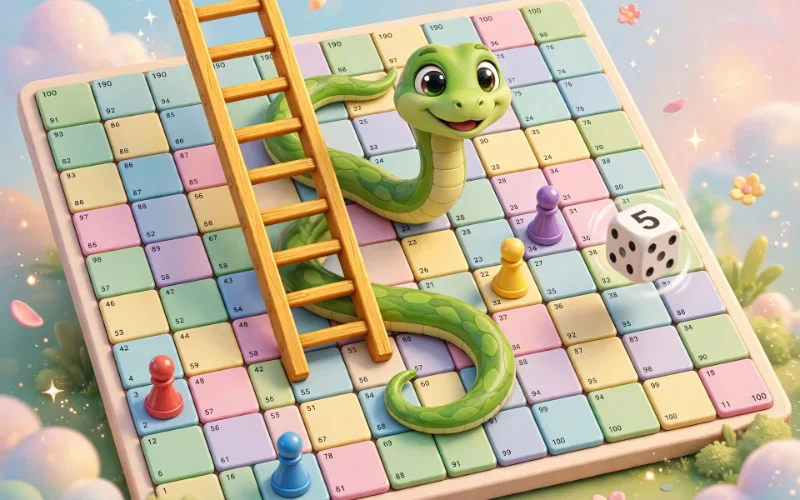
Snakes and Ladders is often the first board game a child learns. You roll a die, climb ladders and slide down snakes, and the first player to reach the last square wins. Few people know that this simple race began in India as a game about life, good deeds and spiritual freedom. This guide covers the rules, the game's fascinating history, popular variations and the honest answer to whether skill plays any part.
How to Play
What You Need
- A board of 100 numbered squares, arranged in a 10×10 grid.
- Several ladders and snakes drawn across the board.
- One six-sided die.
- One token per player. Any number of players can join, though 2 to 4 is most common.
Basic Rules
- All tokens start off the board, just before square 1.
- Players take turns rolling the die and moving their token forward by the number shown.
- The path zig-zags: left to right along the bottom row, then right to left on the next row, and so on up to square 100.
- If your token lands on the bottom of a ladder, climb up to the square at its top.
- If your token lands on the head of a snake, slide down to the square at its tail.
- Landing in the middle of a ladder or snake does nothing. Only the bottom of a ladder and the head of a snake count.
- The first player to reach square 100 wins.
Several tokens can share the same square. There is no capturing in the standard game.
Popular Rule Variations
Families play Snakes and Ladders in many ways. These are the most common variations:
| Variation | How it works |
|---|---|
| Exact roll to finish | You must land exactly on 100. If you roll too high, you stay where you are. |
| Bounce back | If you roll too high, count forward to 100 and then back by the extra amount. You can bounce onto a snake. |
| Six to start | You must roll a 6 before your token can enter the board. |
| Extra roll on 6 | Rolling a 6 gives another turn. Some players cancel the turn after three 6s in a row. |
| Simple finish | Any roll that reaches or passes 100 wins. This makes games shorter, which is good for very young children. |
Agree on the rules before starting. The exact-roll rule is the one most often used in India.
History: From Moksha Patam to Modern Board Game
An Indian Game of Virtue and Vice
Snakes and Ladders comes from an ancient Indian game known as Moksha Patam (also called Gyan Chaupar or Parama Padam in different regions). The game was used to teach moral and spiritual lessons. The board represented a journey of life, and the goal was to reach moksha, liberation from the cycle of birth and rebirth.
In these old boards, ladders stood for virtues such as generosity, faith and humility, and snakes stood for vices such as anger, greed, lust and theft. Landing on a virtue lifted the player closer to liberation, while a vice dragged them back down. Traditional boards usually had more snakes than ladders, reminding players that the path of goodness is harder than the path of wrongdoing.
The game's exact origins are uncertain. It is often linked to the 13th-century Marathi saint-poet Dnyaneshwar (also written Gyandev), though versions of the game may be older. Jain, Hindu and other traditions all had their own boards, each with its own set of virtues and vices.
Journey to the West
During British rule, the game travelled to England, where it became popular in the late 19th century as "Snakes and Ladders". The moral meaning was softened, and Victorian boards showed good and bad deeds of children instead. In 1943, an American version called Chutes and Ladders replaced snakes with playground slides. Today the game is played all over the world, but it remains especially loved in India.
Fun Facts
- Some traditional Moksha Patam boards had 72 or 84 squares rather than 100.
- Old boards often had the final square represent the home of a deity, symbolising spiritual liberation.
- Because each move is determined by the die, mathematicians use Snakes and Ladders as a classic example of a Markov chain, a type of random process studied in probability.
- A single game can be over in a few turns or last a very long time, depending on how many snakes you meet.
Is Snakes and Ladders Luck or Skill?
The honest answer: it is pure luck. In the standard game, you never make a choice. Every move is decided by the die, so a five-year-old has exactly the same chance as a grandmaster. That is not a weakness. It is the reason the game is perfect for families, since anyone can win.
Even without choices, the game still teaches useful things to children:
- Counting and number recognition from 1 to 100.
- Taking turns and following rules.
- Handling setbacks calmly, since everyone hits a snake sometimes.
- The original moral lesson that good actions lift you up and bad ones pull you down.
Tips for a Better Game Night
- Use the simple finish rule for small children and the exact-roll rule for older players.
- Let children count squares aloud to practise numbers.
- Tell the story of Moksha Patam before you play to make the game more meaningful.
- Playing online removes the counting work, which keeps games quick and fair.
FAQ
Who invented Snakes and Ladders?
It began in ancient India as Moksha Patam, a game teaching the value of good deeds. It is often linked to the saint-poet Dnyaneshwar, but its true origin is uncertain and may be even older.
Do you need an exact roll to win?
It depends on the rules you agree on. Many players in India require an exact roll to land on 100, while some allow any roll that reaches the end.
Is there any strategy in Snakes and Ladders?
No. In the standard game there are no decisions, so the result depends entirely on the dice.
What do the snakes and ladders represent?
In the original Indian game, ladders represented virtues and snakes represented vices, showing how actions shape a person's spiritual journey.
Roll the dice and see how far luck takes you: play Snakes and Ladders free on GameChakra. If you prefer a game where your choices matter, check out our Ludo rules and strategy guide.