Minesweeper Strategy Guide: Patterns, Chording and Smart Guessing
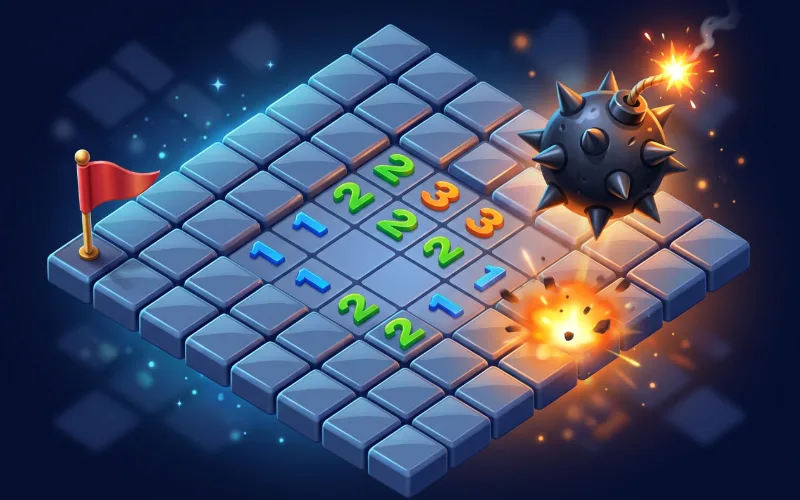
Minesweeper has a reputation as a guessing game, but almost every move in a good game is pure logic. The numbers tell you exactly where the mines are, once you learn to read them in groups. This guide covers how to read numbers, the patterns that experienced players recognise instantly, how to flag and chord efficiently, and what to do in the rare moments when you really must guess.
The Basics
- The board is a grid of covered cells. Some hide mines.
- Reveal a safe cell and it shows a number: how many mines touch it, counting all eight neighbours (including diagonals).
- A cell with no neighbouring mines opens automatically along with its surroundings, which is why you sometimes clear a big area at once.
- You win by revealing every safe cell. You lose if you reveal a mine.
In Mine Hunter on GameChakra, your first tap is always safe and opens up a starting area. Right-click or long-press a cell to place a flag.
Reading Numbers
Every number is a small equation: "the covered cells around me contain exactly this many mines." Two simple cases solve a lot of the board:
- Number equals covered neighbours. If a 2 touches exactly two covered cells, both are mines. Flag them.
- Number already satisfied. If a 1 already touches one flagged mine, every other covered cell around it is safe. Open them.
Most of a game is just repeating these two checks. Remember to subtract mines you have already found: a 3 that touches two flags behaves like a 1 for the remaining cells.
Common Patterns
When the two simple checks are not enough, compare neighbouring numbers. The following patterns appear along a straight edge of revealed numbers with a row of covered cells beside them.
The 1-1 Pattern
Imagine two 1s side by side along a wall, where the first 1 is at the end of the row (against the board edge or a revealed area). The first 1 can only see two covered cells, and both of those cells are also seen by the second 1. Since the second 1 has only one mine and it is already among those shared cells, the third covered cell next to the second 1 is safe.
The 1-2 Pattern
When a 1 sits next to a 2 along a wall, look at the covered cell next to the 2 that the 1 cannot see. The 2 needs two mines, but at most one of them can be in the cells it shares with the 1. So the cell on the far side of the 2 is a mine.
The 1-2-1 Pattern
Three numbers in a row reading 1-2-1 along a wall: the cells directly beside each 1 are mines, and the cell beside the 2 is safe. This is one of the most common patterns in the game and worth memorising.
The 1-2-2-1 Pattern
For 1-2-2-1 along a wall, the two cells beside the 2s are mines, and the cells beside the 1s are safe.
| Pattern (along a wall) | Result |
|---|---|
| 1-1 starting at an edge | Third cell is safe |
| 1-2 | Cell beyond the 2 (not touching the 1) is a mine |
| 1-2-1 | Mines beside the 1s, safe beside the 2 |
| 1-2-2-1 | Mines beside the 2s, safe beside the 1s |
Patterns are shortcuts, not magic. If you are unsure, go back to the logic: for each number, count the mines it still needs and which covered cells it can see.
Flagging: Helpful, Not Required
Flags are just reminders for you. The game does not need them to finish. Beginners should flag every mine they identify, because it makes the numbers easier to read and prevents accidental clicks. Speed players sometimes skip flagging entirely, but that only pays off once pattern reading is automatic.
Never place a flag "just in case." A wrong flag will mislead you later and can make you reveal a mine.
Chording: Clear Cells Faster
Chording lets you open all the remaining neighbours of a number in one action. When a number already has the correct count of flags around it, tap or click the revealed number and every other covered neighbour opens. In Mine Hunter, simply tap a revealed number to chord.
Chording is fast, but it is only as reliable as your flags. If one flag is wrong, chording will open a mine. Double-check before you chord near uncertain areas.
A Good Order of Play
- Start by clearing all the obvious cells around the opening area.
- Work along the edges of revealed regions, looking for the simple checks and patterns.
- When one area stalls, move to another. New information often travels back to the stuck area.
- Use the mine counter near the end. If you know how many mines are left, you can sometimes solve the last few cells by counting.
When You Have to Guess
Sometimes logic genuinely runs out, for example when two cells share one mine and nothing else touches them (a 50/50). When that happens, guess smartly:
- Guess early. If a forced guess is unavoidable, make it as soon as you spot it. Losing early costs less time than losing at the end.
- Pick cells that give information. A cell that might open new numbers is a better guess than an isolated corner.
- Compare odds. A cell next to a 1 with three covered neighbours has roughly a one-in-three chance of being a mine. A random cell far from any number has odds close to the overall mine density, which is often lower.
FAQ
Is Minesweeper all luck?
No. Most boards can be solved mostly or entirely with logic. Luck only matters in occasional forced guesses, and skilled players reduce those by choosing which cells to open.
What does chording mean in Minesweeper?
Chording means clicking a revealed number that already has the right number of flags around it, which opens all its other covered neighbours at once. It saves a lot of time.
Is the first click always safe?
In most modern versions, including Mine Hunter on GameChakra, yes. The mines are placed after your first click so it never ends the game.
How do I get faster?
Learn the 1-2-1 and 1-2-2-1 patterns until you see them instantly, use chording, and practise on smaller boards before moving to larger ones.
Ready to sweep? Play Mine Hunter free on GameChakra and climb through levels that get bigger and trickier. If you like logic puzzles, our Sudoku tips for beginners use a very similar way of thinking.